
Stock and vehicles
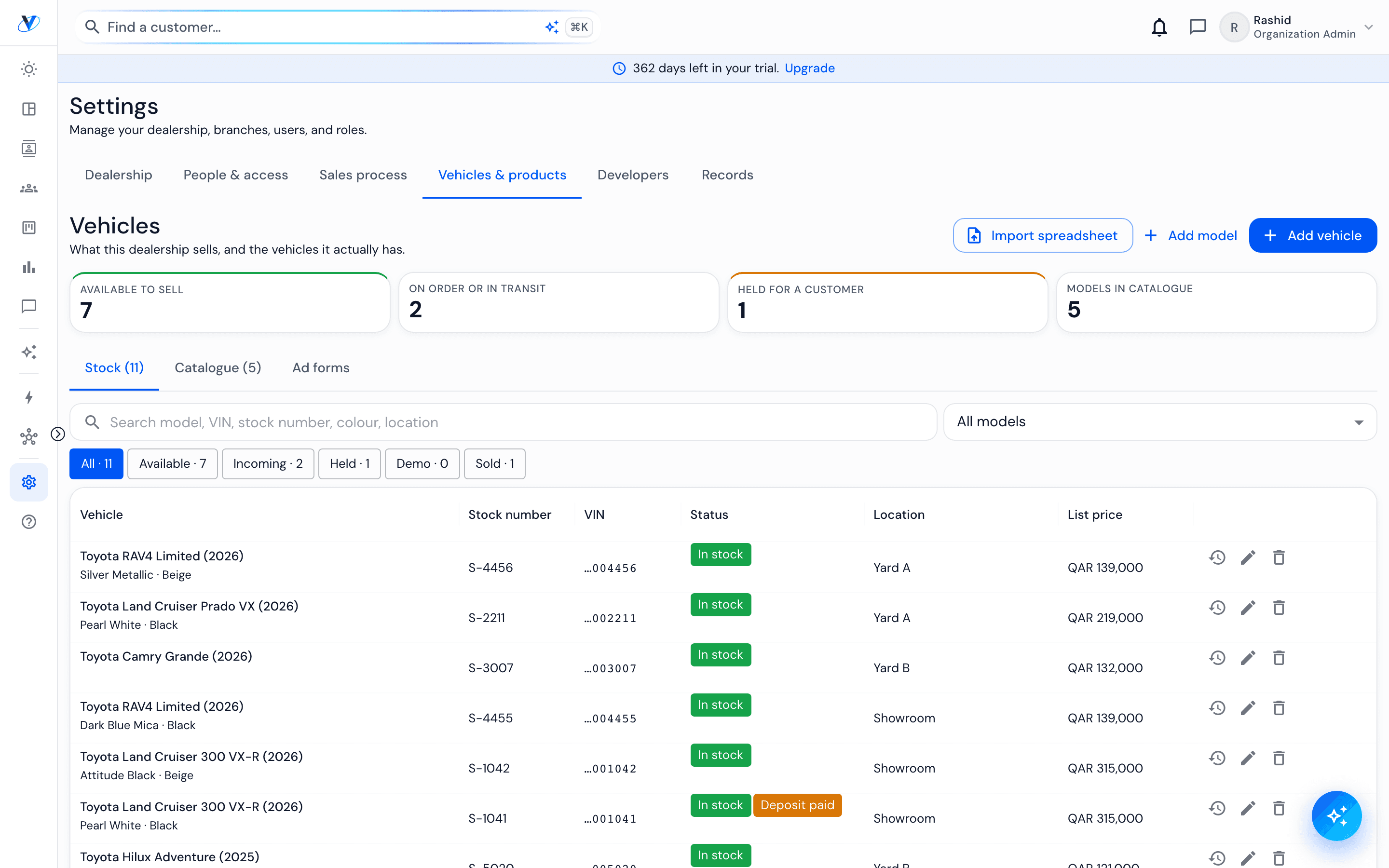
Vorniqe keeps the catalogue and the physical cars apart, because a customer wants a Land Cruiser right up until the moment they want the white one with twelve kilometres on it. The catalogue is what an enquiry points at; the units are what gets reserved and handed over.
How it works
- 01
Add the models you sell
Make, model, variant, body type and year. Keep this list short and real: it is what a salesperson picks from when recording what a customer is interested in.
- 02
Add the physical cars
Each unit carries a VIN, your own stock number, colour, mileage, location and price. A car in stock must have a VIN — a car you cannot identify is a car you cannot sell twice safely.
- 03
Use the states honestly
On order, in transit, in stock, sold. A car that has not arrived is not stock, and pretending otherwise is how two customers get promised the same delivery date.
- 04
Read availability, do not maintain it
Nothing marks a car as reserved. Availability is worked out from live holds and completed handovers, so it is always right and can never drift from the truth.
Worth knowing
Marking a car as a demo does not change its state. A demo car is still in stock, still has a VIN, and still gets sold eventually.
A unit is attached to nothing. A reservation is what joins one car to one enquiry, and a handover is what joins it to a person — because the car outlives both.